
Dental powder, chews and brushing: what actually reduces plaque

Dental powder, chews and brushing: what actually reduces plaque
Dental disease is the most common health problem in adult dogs and one of the least visible until it is advanced. It is also the area with the widest gap between what products claim and what they do, so here is our honest ranking.
What plaque actually is
Plaque is a soft bacterial film that begins forming on a clean tooth within hours. Left alone, minerals in saliva turn it into tartar — the hard brown deposit at the gum line — in about two or three days. Plaque can be removed at home. Tartar cannot; that needs a scale under anaesthetic.
Everything below is judged on one question: does it disrupt plaque before it mineralises?
1. Brushing
Nothing else comes close. Mechanical disruption of the film every day or two is the only method that reliably keeps the gum line clean, and it is free apart from the brush.
The obstacles are practical. Most dogs are not introduced to it, most owners give up in week one, and most people aim at the wrong surface. The outer face of the upper back teeth is where tartar accumulates; the inner surfaces are largely cleaned by the tongue. Thirty seconds a side, angled at the gum line, beats two minutes of scrubbing the fronts.
Build it slowly: a week of just letting the dog lick paste off a finger, a week of a finger along the gums, then the brush. Use dog toothpaste — human paste contains fluoride and sometimes xylitol, which is dangerous to dogs.
2. Dental powders and water additives
Powders sprinkled on food, and the newer chew-toy powders that coat a rubber toy, work by changing the chemistry at the tooth surface — usually with enzymes or with seaweed-derived compounds that make plaque less able to mineralise.
The honest assessment: they help, they are not a substitute for brushing, and they suit dogs that will not tolerate a brush. Their real advantage is compliance — sprinkling a scoop on dinner takes three seconds and people actually keep doing it, whereas a brushing routine that requires wrestling gets abandoned by February.
Look for a product that specifies what it contains and at what dose. “Proprietary blend” on a dental powder is a request to take it on faith.
3. Chews and chew toys
A chew works by abrasion, and abrasion only cleans where the tooth meets the chew. That means the tips of the canines and the outer edges of the carnassial teeth get scrubbed and the gum line largely does not. Useful, partial.
Two cautions. Hard chews — antlers, hooves, bones, hard nylon — fracture teeth, and a slab fracture of a carnassial is an expensive extraction. The rule of thumb: if you cannot dent it with a thumbnail, it is too hard. And chews are food. A daily dental chew for a small dog can be a tenth of its calories.
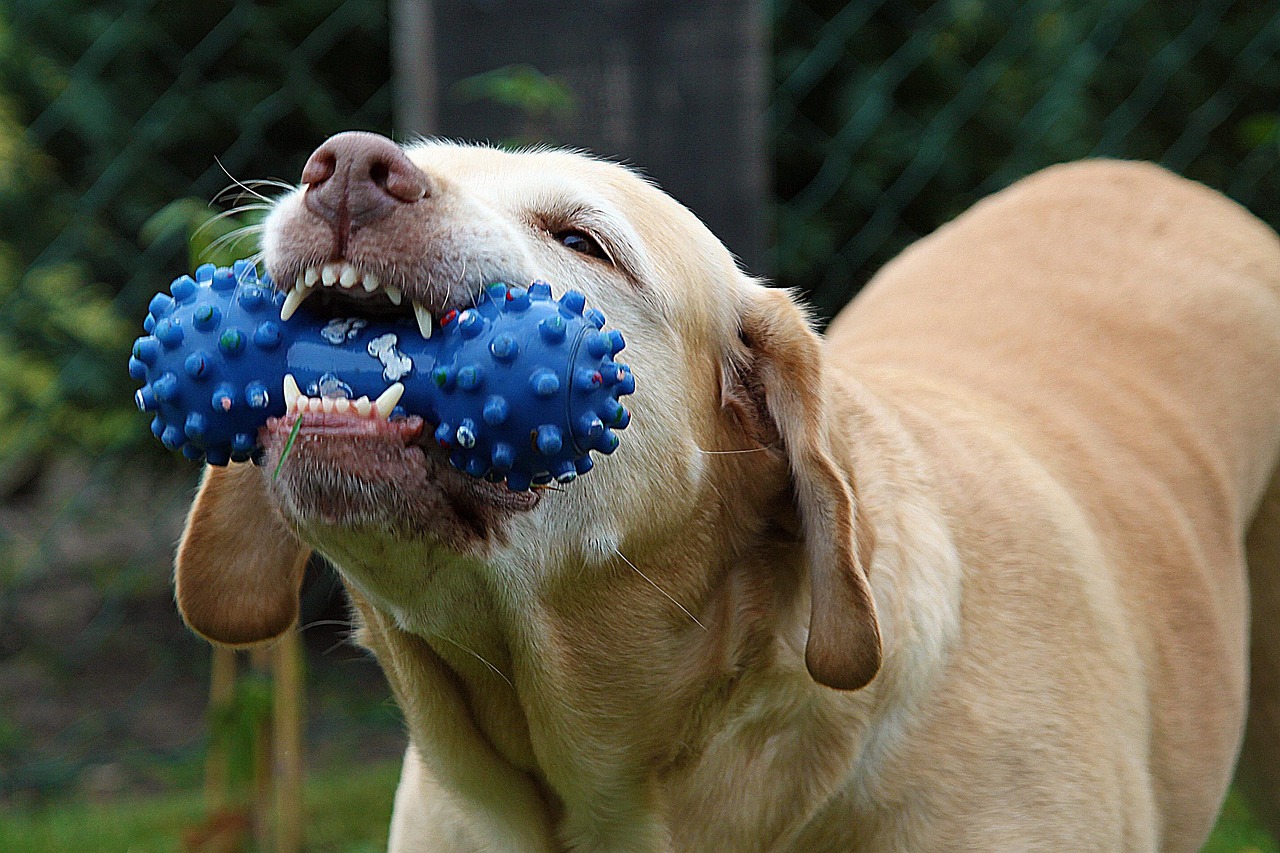
The rubber toys that hold a dental powder or paste are a reasonable compromise: the chewing provides abrasion and the powder does the chemistry, at low calorie cost.
4. Dental diets
Kibble engineered with a fibre matrix that stays intact as the tooth passes through it, so the tooth is wiped rather than shattering the piece. These do work, measurably, and they only work if they are the whole diet.
5. Things that mostly do not work
- Ordinary kibble. The “dry food cleans teeth” idea does not survive contact with the evidence — standard kibble shatters on first contact.
- Anaesthesia-free scaling. Removes visible tartar above the gum line, leaves the sub-gingival plaque that causes the actual disease, and requires holding a conscious animal still with sharp instruments near its gums.
- Anything promising to dissolve tartar. Tartar is calcified. Nothing you can safely put in a dog’s mouth dissolves it.
A routine most people can keep
- Brush the outer surfaces of the back teeth, three or four times a week, thirty seconds a side.
- A dental powder on food daily for the days brushing does not happen.
- A soft chew a few times a week, counted as part of the calorie budget.
- Lift the lip once a month and look at the gum line above the upper back teeth. Red edges or brown build-up means it is time for a vet.
Cats
Everything above applies, with the difference that cats hide dental pain almost completely, and feline resorptive lesions are both common and genuinely painful. A cat that has started eating on one side, dropping food, or grooming less deserves a dental examination, not a chew.
What we stock and why
We keep a dental powder for the chew-toy route and a small range of soft chews, because those are the two things people keep using. Ask at the counter and we will happily tell you that the toothbrush behind you is the better buy.
What a professional clean actually involves
Owners are often surprised by the cost of a veterinary dental, so it is worth knowing what is being paid for. The animal is anaesthetised because the important work happens below the gum line, where a conscious animal will not tolerate an instrument. Full-mouth radiographs come first, since roughly half of significant dental disease in dogs and cats is invisible above the gum. Then scaling of every surface of every tooth, extraction of anything unsalvageable, and polishing, because a scaled tooth left rough collects plaque faster than one that was never touched.
The reason to keep up a home routine is not to avoid that appointment for ever. It is to make it a cleaning rather than a series of extractions, and to push the interval from every year out to every three or four.
Signs worth acting on early
- Breath that has changed character, not merely “dog breath” — a sour or rotten note is bacterial
- Chewing on one side, or dropping food that used to be eaten easily
- A red line along the gum where it meets the tooth
- A loose tooth, or one that looks longer than its neighbours because the gum has receded
- Pawing at the mouth, or shying away when the muzzle is touched
None of those improves on its own, and all of them are cheaper to deal with in the month they appear than in the year afterwards.
Starting with a dog that hates it
Do not begin with a brush. Begin with a finger and something the dog wants to lick off it, once a day, for a week, with no attempt to touch a tooth. Then a finger along the outside of the gums for a few seconds. Then a finger brush. Then, if it is going well, a proper brush. Rushing this takes a fortnight and produces a dog that runs when the tube comes out; doing it slowly takes a month and produces a dog that sits still for the rest of its life.